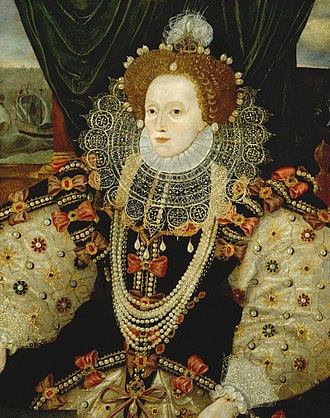
The Queen:
The later queen of England was born to King Henry VIII and his second wife; Anne Boleyn. Soon after her birth, her mother was executed after an annulment of her marriage to the king. Anne was executed for adultery, although most believe it was only a poor cover for the fact that he wished for a son. Whom she could not have; the entire incident led to Elizabeth being announced illegitimate like her older half sister Mary. Her father got married again simply 11 days after the execution. This marriage gave her brother who would, after Henry’s death, take over the crown. After the death of both her half siblings, Elizabeth was titled queen. This was possible because, as much as Henry wanted a son; his main goal was to keep the bloodline alive. Due to which he brought the third succession act in and got his daughters back in line for crown after their brother. She was an extremely learned woman, under whose rule the country flourished in peace. A popular nickname given to her was ‘The virgin queen’; indicating her lack of kids and marriage
Background:
The Elizabethan Era started with the reign of Elizabeth I. It was a bright contrast to the earlier reigns that had now begun to have a history in ending quickly and tragically. Her father’s reign had ended after successfully having married 6 women and getting 3 of kids declared illegitimate as his marriages with their mothers was annulled; only to change law and get two of them back in line for crown. The remaining boy was a child from his infamous mistress [the name is unknown]. There was a lot of patriarchal view included when choosing who would the heir be. This also led Henry into annulling 2 marriages and getting one of them beheaded. His third wife gave him the son he so madly wished for; but he barely reigned for 6-7 years before dying of tuberculosis. After him, the elder of the two sisters, Mary, was appointed as queen. But before her, there had been an attempt on the boy’s side to appoint a cousin rather than his sister. In the end, Mary’s supporters were much larger in number which led to her being queen. She was a conventional ruler and wanted to bring back all the old laws and traditions that her father had cancelled. Her reign lasted for 5 years; during which she had around 300 protestants killed. After her death [cancer] Elizabeth finally gained reign.
Politically:
More commonly known as the ‘Golden Age’ of English history, the Elizabethan Era brought with it many changes to the country. Like with any other monarch, her views were well debated on; though nobody could raise a finger at the fact that they brought the country great peace. They were not very strong in a military sense; but they avoided major defeats and built a strong navy. The queen generally increased prosperity by stealing from Spanish treasure ships, raiding settlements with low defenses, and selling African slaves. Having inherited a virtually bankrupt state from previous reigns, her frugal policies restored fiscal responsibility. Her fiscal restraint cleared the regime of debt by 1574, and ten years later the Crown enjoyed a surplus of £300,000. Henry VIII had launched the Royal Navy, but his first two heirs had ignored it. Leaving it to be a mere coastal defense. Elizabeth worked on making it one of their strengths; she supported certain ‘Sea Dogs’ who preyed on Spanish merchant ships. Due to this she faced war with Spain. They weren’t very strong, but defeated the Spanish Armanda. It was mainly due to the over complicated plans on Spain’s side, but England won.
Art and Culture:
The Elizabethan Era is particularly known for its art and literature. Many playwrights and painters emerged during this time. Shakespeare and Marlowe were popular names in theatre. Likewise, Edmund Spencer, Richard Hooker and John Lyly were popular among Literature enthusiasts. Theatre was full of historical works, along with comedies and tragedies. While in Literature many new forms of writing were introduced. Such as sonnet, Spenserian stanza and dramatic blank prose, as well as prose. Historical chronicles were also introduced around the same time. It was called the ‘English Renaissance’. Travelling Musicians were in demand by court, churches and country houses, as well as local festivals. Some popular artist were; William Byrd, John Dowland, Thomas Campion and Robert Johnson. The privileged took part in pastimes such as jousting and gambling. Jousting was quite considerably dangerous and had killed many men. Religiously, the Queen, like her father, was a protestant and officially established the church of England by separating it from Rome.
By,
Janx
Picture Credits: Wikipedia
 J's Musings
Leave a comment